Becoming a director of a Dutch company: a guide to limiting your liability risks
You are about to become part of the existing board of a Dutch company (a B.V.). How do you assess and limit your liability risks before and shortly after taking up the role? In this guide, we provide a (1) checklist and (2) do’s and don’ts list.
By Joost Jansen
Expertise:
Dispute Resolution
27.11.2026
Becoming a director of a Dutch company: a guide to limiting your liability risks
You are about to become part of the existing board of a Dutch company (a B.V.).[i]
Good news is: as a starting point, the B.V. is liable for its own debts and you do not have to step in. Still, you do face some risk of personal liability. As a director, you may face claims relating to losses resulting from mismanagement that arose before you joined or occur soon after you start. There is no general rule that protects new directors from these risks. How do you assess and limit your liability risks before and shortly after taking up the role? In this guide, we provide a (1) checklist and (2) do’s and don’ts list.
In short
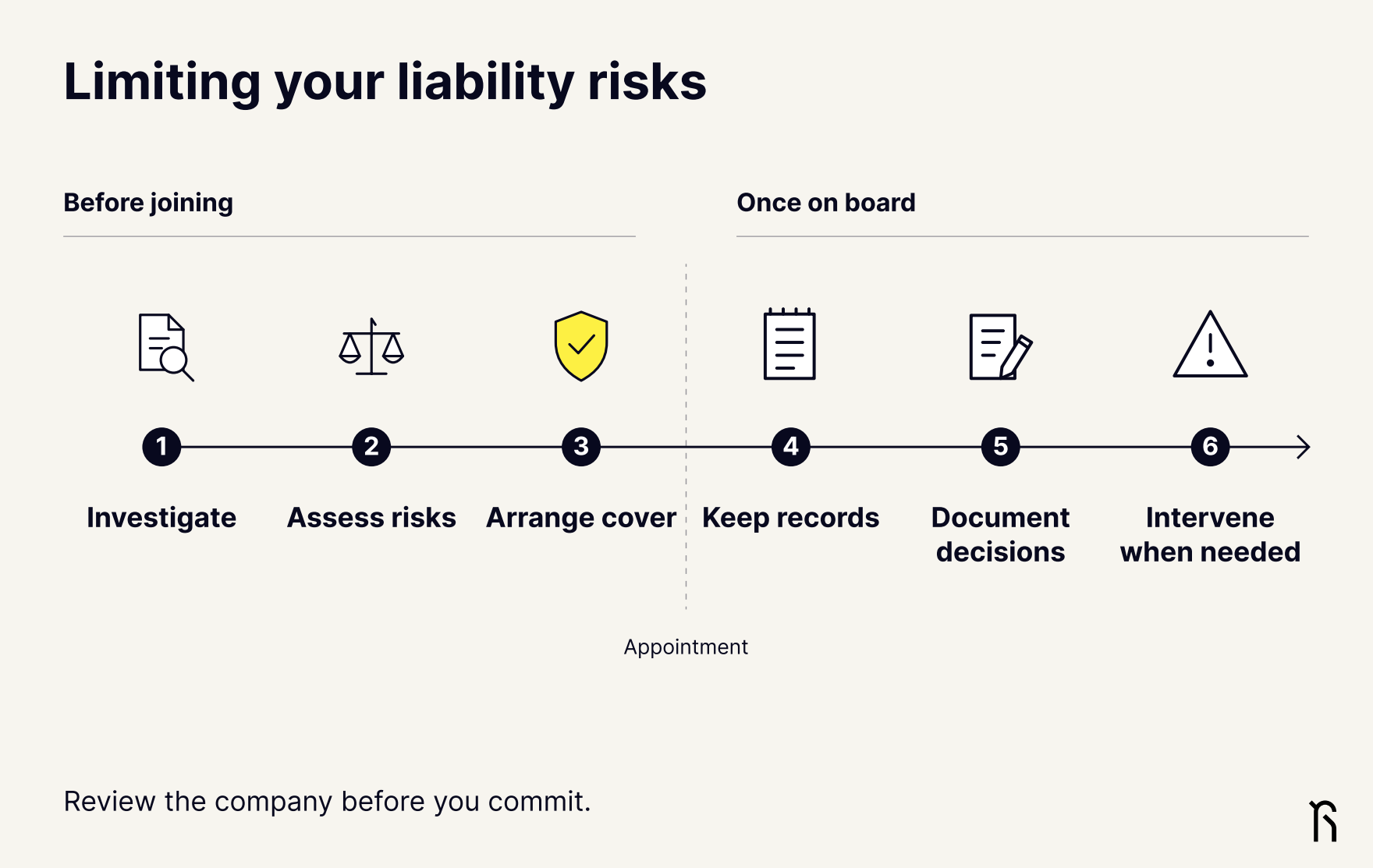
As a best practice, you can carry out a brief due diligence into the company you are about to join. It will result in identifying risks and implementing potential mitigation measures when it is still meaningful, in addition to simply getting to know the company. Use the checklist below.
Depending on the risks, you can set conditions before accepting your appointment. A directors’ and officers’ (D&O) liability insurance (bestuurdersaansprakelijkheidsverzekering) policy is a best practice.
After your appointment, the interest of the company and its enterprise is always your guiding principle. Be aware of your responsibilities and tasks (among other things: make sure to keep good records). Be alert to situations in which you must act, stop entering into obligations, or even resign.
Step 1: A checklist of information to request from the current board
You may already have a connection with the company (as an employee or adviser, for example), or you may be new. In either case, request up-to-date information from the current board before taking the helm. Review the documents carefully, on your own or with an advisor. The following information should always be included:
D&O insurance. Documentation for all insurance policies covering board members (and supervisory board members, if any). A D&O insurance policy will cover most types of claims if directors are held liable.
Board governance documents. The up-to-date articles of association (statuten), any board rules (bestuursreglement), the shareholders’ agreement (aandeelhoudersovereenkomst) and the company’s main policies. These documents show who decides what, and which approvals you need before the board can act.
Main risks. Discuss the company’s main risks from an operational, IT, commercial and compliance perspective, and how these are being managed. This gives you a picture of risks and priorities that do not (yet) show up in the documents.
Annual accounts and financial administration. Filed and adopted annual accounts from previous financial years, and the records – notably the balance sheet and profit and loss statement – for the current year. This lets you assess the company’s financial position.
Debts, assets and key contracts. If not already clear from the documents provided, a detailed overview of all major debts, material loans, assets and subsidies.
Bank documentation. Include, in any case, all credit and loan agreements, security arrangements and guarantees, plus (a summary of) recent correspondence with the bank to see which commitments you inherit on day one. These documents may contain restrictions on what the company may and may not do, such as financial covenants, limits on further borrowing or distributions, and change-of-control clauses.
Filing of annual accounts. The Chamber of Commerce (Kamer van Koophandel) registry shows whether all annual accounts have been filed on time. A failure to do so is a liability risk.
‘403 declaration’. Details on whether the company or its group companies have issued a liability declaration for certain group debts.[ii] Mistakes are easily made here and they represent a liability risk.
Ownership structure. An up-to-date cap table allows you to see which shareholders or other economic beneficiaries you will be working.
Legal actions and disputes. A list of all legal proceedings and disputes from the past three years (including judgments, arbitration, binding advice and settlements). Ask for a summary of all ongoing or threatened actions or regulatory interventions affecting the company or its assets.
Discharges and indemnities. An overview of annual and final releases (such as discharge votes) and indemnities against personal liability that have been granted in favour of (previous) directors. Annual discharge only covers liability towards the company, and only for matters that were disclosed to the general meeting. This overview may also reveal conflicts or discussions within the company.
Regulatory investigations.
An overview of regulatory reviews, official requests or interventions by authorities (such as the Dutch Tax Authorities, financial markets regulators or the public prosecutor), including any known circumstances that may lead to an investigation or claim. In particular; details of tax claims, any notification of inability to pay taxes, or other recent correspondence with the Dutch Tax Authorities.
An overview of (potential) breaches of statutory requirements or anything reported/requested by regulators that could affect the company or its operations.
Transactions and investments. A list of all material transactions and investments for the past five years. This provides insight into how the company is funded and changes in its control structure. If the company has been acquired, you should also be given insight into details of any conditional or potential obligations that remain – as with guarantees or indemnities provided to a buyer.
Other information. The list above can be further expanded, depending on the nature of the business. Request any other relevant information or documents that, in the view of the current board, you will need to determine whether to join.
Step 2: Do’s and don’ts
(1) Assessing and limiting your risks before taking up the role
Review all requested information, if need be, with appropriate advisors. On this basis, you may wish to ask the board to clarify certain points. Do not be afraid to ask questions. If not now, when?
Make yourself familiar with the administrative and financial systems of the company: who keeps the records, which systems are used and how reliable the reporting is. If you notice that the administration is not properly maintained, or that annual accounts have not been filed, give this priority (see (5) below).
There are various ways to manage these risks. You might, for example, want to request specific indemnities from the company or its shareholders in relation to identified risks. Your lawyer can help in this process. It always comes down to a judgment call, balancing the risks with the terms on which you join the board, including the remuneration you receive under your management or employment agreement. If your review reveals too many unresolved issues, you may decide not to become a director after all.
(2) Taking out D&O insurance
It is advisable to insist that the company arranges D&O insurance on your behalf. Have your lawyer review the policy terms closely. Focus on the insured amount, policy period, exclusions, and any other facts that could cause the cover to lapse. Bear in mind that, even where a claim has little prospect of success, cover for legal defence costs is valuable.
If a D&O insurance is adopted, make sure that all conditions continue to be met. These include payment of the insurance premiums, but also often require prompt notification after becoming aware of a potential claim.
(3) Guiding principle after joining the board: the interest of the company and its enterprise
If you join the board, your specific duties will depend on the business and how responsibilities are divided. Still, for every company, one principle applies: you must act in the interest of the company and its enterprise.[iii]
In general, that means promoting the long-term success of the enterprise. We discuss this principle further in our guide for directors navigating a company in financial distress.
(4) Bearing in mind: every director is responsible for management of the company
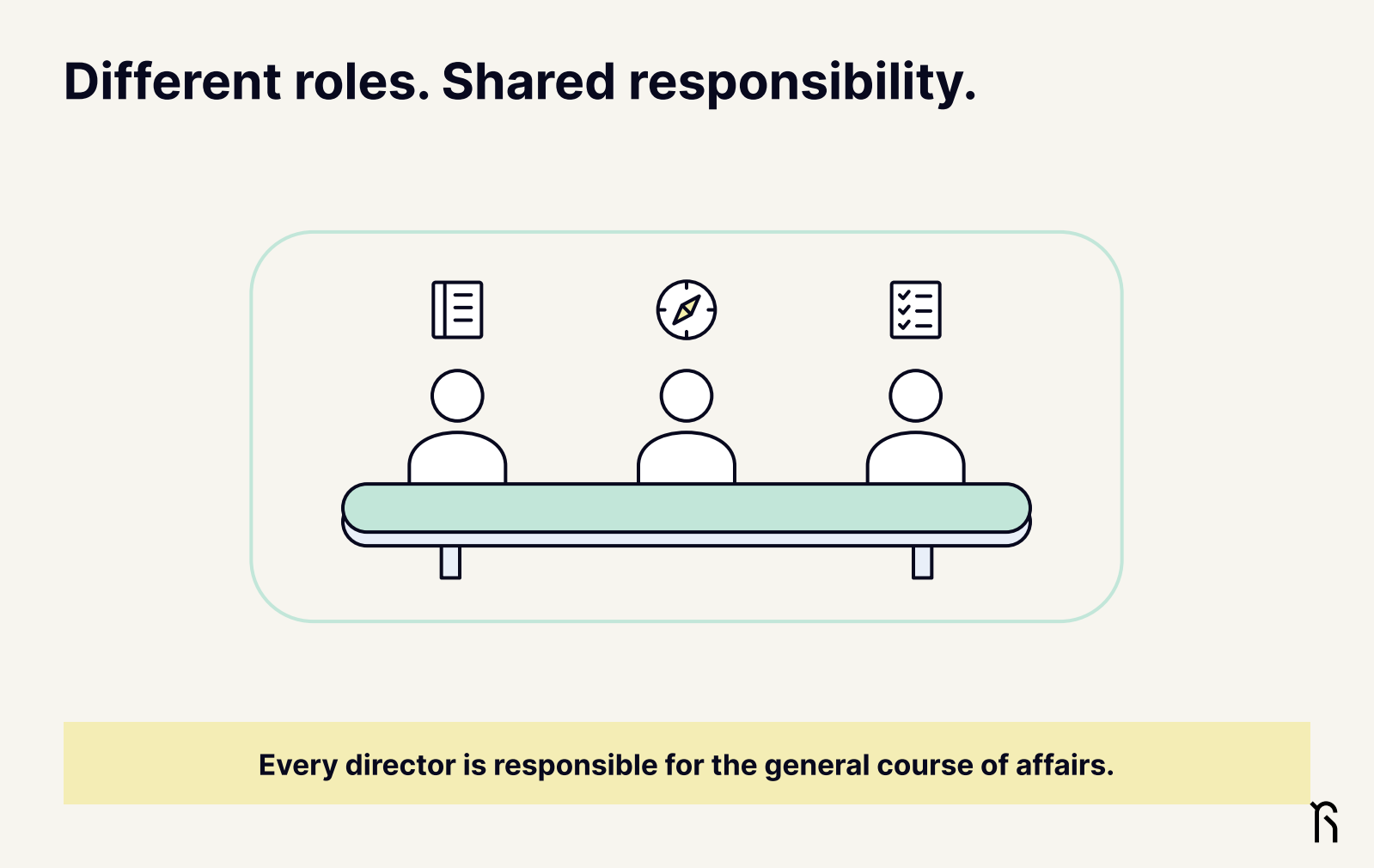
You and your fellow board members manage the company as a collective. Every director is responsible for the general course of affairs,[iv] even where tasks are divided among the directors. If the company, or a bankruptcy trustee (curator) in the event of bankruptcy, takes action against the board, they generally target the entire board. Suppose the board has acted in a seriously culpable (ernstig verwijtbaar) manner: the new directors will then also need to mount a defence.
Your defence will generally succeed if the loss occurred before you became a director: you can distance yourself from it, because you were not yet in office.
Matters become more complicated if the improper management took place after you joined. The principle of collective responsibility means that all directors can be held liable for improper management towards the company or, in bankruptcy, the bankruptcy estate. The bar is high, but the general rule stands: you are collectively responsible. If the board is headed for a decision you disagree with, it is not enough to vote against it. You must be able to show you did not permit improper management (onbehoorlijk bestuur). Directors are expected to supervise one another and to intervene where a fellow director falls short, for instance by asking the supervisory board (if any) or the general meeting to act. Resigning demonstrates in the clearest terms that you did not tolerate the misconduct.
Where a third party, a creditor for example, holds you liable, a slightly different rule applies. The claimant must, for each individual director, set out and, if necessary, demonstrate that the acts of a specific director were so careless that a serious reproach can be made against that director (persoonlijk ernstig verwijt).
If, as a new director, you are pursued for losses that occurred before you started, the same defence applies: you were not a director, so cannot be held seriously at fault yourself.
For losses arising after you took office, you can also be held liable if a claimant can demonstrate the serious reproach. A management ban (bestuursverbod) does not apply to a director who cannot be seriously blamed, for example because they had only recently joined and tried to prevent the prohibited activities (Article 2:20a(1) DCC).
(5) Good bookkeeping and administration are essential
As a board, you are jointly responsible for the financial administration and the annual accounts, including their timely filing. This applies to every director, not just the CFO: a division of tasks does not remove that responsibility.[v] The company’s accounts, including intra-group current accounts and receivables, must be kept up to date at all times.
The aim is straightforward: to give a simple and complete picture of creditors/debtors and the company’s liquidity position at any moment.
Failing to meet these record-keeping (boekhoud- en administratieplicht) duties creates liability risk. In bankruptcy, this risk is increased by an extra rule that helps the bankruptcy trustee: if the records or annual filings have not been properly kept, improper management is presumed to have been an important cause of the company’s bankruptcy. Then, you have to prove that was not the case.
(6) In financial distress, the company’s priorities must shift
This guideline depends on having a good understanding of the financial position. As soon as you know, or reasonably ought to know, that bankruptcy is virtually unavoidable, your focus must shift from the company’s continued success to preserving value for the joint creditors.
Take extra care with payments from this point onwards: be aware especially of selective payments, set-offs (even within the group), and transactions that result in assets leaving the company. Seek advice.
Do not enter into new obligations if you know, or reasonably ought to know, that the company will not be able to meet them and will not offer the counterparty recourse for its damage (the Beklamel norm). A typical example is placing a large order while knowing that the company cannot pay for it. That could lead to personal liability. Third parties such as creditors can successfully pursue directors in these cases – if a court finds the director can personally and seriously be blamed.
(7) Thoughtful decision-making and knowledge of the articles of association
All board decisions should be well documented. This is vital in all situations, even more so in tough times. Make sure you can always go back and reconstruct the thoughts behind your decisions. Pay close attention to conflicts of interest: these involve any direct or indirect personal interest in conflict with the company’s interest. In such cases you may not take part in the deliberations and decision-making.[vi] The articles of association may add further rules, for example by requiring another body to approve certain decisions. Study them and ask for advice if you are unsure. Breaching the articles can itself result in director’s liability. For example, if the board enters a major contract but another body should have approved it under the articles (and did not), you could be held liable for the loss.
In conclusion
This guide has briefly outlined some best practices in the period before, and the responsibilities and risks shortly after you become a director of a Dutch B.V. This is not an exhaustive guide. Use our checklist and do’s and don’ts list: take steps to address the risks, know your responsibilities, and identify the moments when you must act, stop entering into new obligations, or step down. Are you about to join a board and would you like to assess the risks first?
Please do not hesitate to reach out to further discuss.
[i] In this guide, we have used the B.V. (besloten vennootschap) as our example and refer to this as “the company.” Similar rules apply for other entities, such as the N.V. (naamloze vennootschap), foundation (stichting), association (vereniging) or cooperative (coöperatie).
[ii] Article 2:403 of the Dutch Civil Code (DCC)
[iii] Article 2:239(5) DCC
[iv] Article 2:9(2) DCC
[v] Article 2:9(2) DCC
[vi] Article 2:239(6) DCC